


The American Dream Rail (ADR) is a proposed all-electric, high-speed rail system designed to carry standard 53-foot truck trailers, offering several advantages over conventional semi-trucks for long-haul transport. Here’s a concise comparison across key aspects:
- Speed and Travel Time: ADR can transport trailers at speeds up to 100 mph, potentially halving travel times for long distances compared to semi-trucks, which typically average 55-65 mph on highways due to speed limits, traffic, and driver restrictions per DOT regulations.
- Energy Efficiency and Fuel Consumption: As an all-electric system, ADR uses renewable energy sources with minimal energy loss, achieving far higher efficiency (equivalent to over 100 mpg in truck terms) than diesel semi-trucks, which get about 6-8 mpg while pulling heavy loads, leading to significant reductions in fuel use.
- Operating Costs: ADR could lower costs by 50-70% per mile through reduced energy expenses, no driver salaries for the rail segment, and lower maintenance on electric systems versus trucks’ engines, tires, and brakes. Initial infrastructure investment, although high, will prove affordable with an amortized term of 125 years, zero interest, and high-volume use.
- Environmental Impact: ADR produces zero direct emissions, cutting greenhouse gases by up to 80% compared to diesel trucks, which emit substantial CO2, NOx, and particulates. It also reduces road congestion and noise pollution.
- Safety: Rail transport like ADR has a much lower accident rate (about 1/10th that of trucking) due to dedicated tracks, automated controls, and no exposure to highway hazards like weather or other vehicles, though loading/unloading adds minor risks.
- Capacity and Scalability: While both handle a single 60,000 lb trailer, ADR trains can operate multiple vehicles up to 2 minute intervals apart for mass transport, unlike individual trucks, enabling economies of scale. However, ADR requires dedicated rail infrastructure and terminals, limiting flexibility compared to trucks’ door-to-door service.
- Driver and Labor Impact: ADR empowers truckers by allowing them to drop off trailers at terminals for rail transport, freeing them for shorter hauls or retraining into rail operations, reducing fatigue from long drives but potentially shifting some jobs.
Consider this:
It is estimated that a total of 100 tons to be transported from Los Angeles to Chicago (2,129 miles) x five 53ft trailers each weighing 40,000 pounds, the American Dream Rail compared to a conventional semi truck system, would achieve the following result: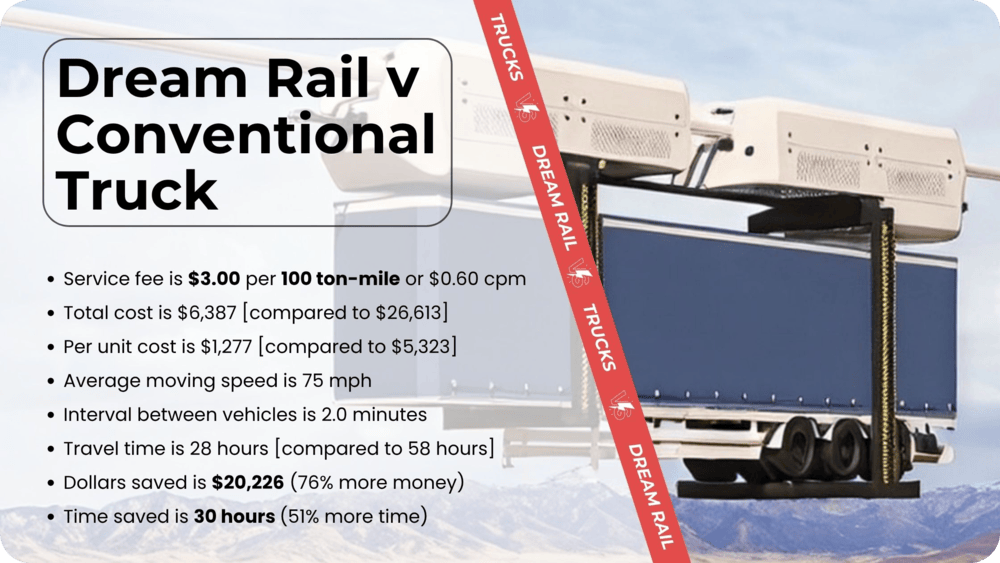 Overall, ADR excels in efficiency, sustainability, and speed for long-haul routes, making it a complementary alternative to trucking rather than a full replacement, especially for reducing highway wear and supporting economic growth through job transitions.
To issue $5.5 trillion in special “U.S. Anniversary Dollars” as you described (a zero-interest, 125-year loan from the Federal Reserve, backed by project revenues, with incremental releases and no immediate fiscal impact), even with majority support in Congress, would require a structured legislative process to grant the Fed explicit new authority. This is because the Fed’s current powers under the Federal Reserve Act (1913) do not allow for direct issuance of special commemorative currency or interest-free loans of this nature and scale without congressional authorization—it’s not something the Fed can do unilaterally or via a non-binding resolution.
Congress has amended the Act over 200 times historically to expand or adjust the Fed’s tools (e.g., for emergency lending during the Great Depression or monetary policy reforms in 1977), so this would follow a similar path but face significant hurdles due to the unprecedented scale and implications for monetary policy, inflation, and Fed independence. 2 10 12 16 Below is a step-by-step outline of what it would realistically require, based on U.S. constitutional powers, congressional procedures, and historical precedents.
1. Draft and Introduce Legislation as a Bill (Not Just a Resolution)
- Start with a formal bill (e.g., “American Dream Rail Financing Act” or similar), introduced in either the House (as H.R. XXXX) or Senate (as S. XXXX). This must explicitly amend the Federal Reserve Act to authorize the Fed to issue the $5.5 trillion in special currency under your terms (e.g., as a commemorative issuance tied to the 250th anniversary, structured as an interest-free loan held in Treasury trust, with repayment from specific project revenues).
- Why a bill? Under the Constitution (Article I, Section 7), only bills that pass both chambers and are signed by the president become law with binding force. Resolutions (simple, concurrent, or even joint) typically lack this unless they’re joint resolutions functioning as bills. Historical amendments to the Fed Act (e.g., adding Section 13 for emergency lending in 1932 or creating the Federal Open Market Committee in 1933) were done via full bills.
- Key provisions to include: Define the currency’s backing (e.g., project assets, not gold or bonds), set limits on annual releases ($500 billion max), ensure deficit neutrality, and address oversight (e.g., requiring Fed reports to Congress). This draws from precedents like the 1917 amendments for wartime monetary expansion.
2. Committee Review and Markup
- The bill would be referred to relevant committees: In the House, the Financial Services Committee (which oversees banking and monetary policy); in the Senate, the Banking, Housing, and Urban Affairs Committee. 4 16
- Hearings would be held to debate feasibility, with testimony from Fed officials, economists, Treasury, and experts. This is where concerns like inflation risks (from expanding the money supply) or violations of Fed independence would arise.
- Majority support could push it through markup (amending the bill), but opponents might add riders (e.g., requiring GAO audits or inflation safeguards).
- If tied to the debt ceiling (as in your plan), it might also involve the House Ways and Means or Senate Finance Committees, as Treasury handles debt issuance.
3. Floor Votes in Both Chambers
- House: Needs a simple majority (218 of 435 votes, assuming full attendance). With majority support, this could pass via regular order or suspension of rules (requiring 2/3 but faster).
- Senate: Also a simple majority (51 of 100), but the filibuster rule requires 60 votes to invoke cloture and end debate. If your majority is slim (e.g., 51-49), you’d need bipartisan buy-in or use reconciliation (limited to budget-related bills, which this might qualify as if framed as deficit-neutral).
- Amendments could be added on the floor, potentially diluting the plan (e.g., shortening the loan term or adding interest).
4. Reconciliation Between Chambers (If Needed)
- If House and Senate versions differ, a conference committee reconciles them, producing a final bill for revote in both chambers.
5. Presidential Approval
- The president must sign the bill into law. If vetoed, Congress needs 2/3 majorities in both chambers to override (a high bar even with initial majority support). Given the scale, a president might veto over economic risks, as Herbert Hoover did with public-power bills in the 1920s-1930s.
6. Implementation by the Fed and Treasury
- Once law, the Fed (via its Board of Governors) would issue the currency under the new authority, potentially coordinating with the Treasury for holding in trust and disbursement. The Fed has discretion in execution but must comply with the statute.
- For the 24-hour debt ceiling suspension and spending freeze: This would need explicit inclusion in the bill, as current law allows suspensions only via legislation (e.g., the 2023 Fiscal Responsibility Act suspended it until 2025).
7. Overcoming Additional Hurdles
- Legal/Constitutional Challenges: Opponents could sue, arguing it violates the Appropriations Clause (requiring Congress to control spending) or delegates too much power to the Fed (as in debates over the Fed’s constitutionality). Supreme Court review might delay or block it.
- Economic and Political Resistance: Fed Chair testimony could highlight inflation risks; banking lobbies might oppose bypassing traditional debt markets. Bipartisan support would be crucial, as seen in past Fed reforms.
- Timeline: From introduction to law could take months to years, depending on urgency (e.g., attached to must-pass bills like appropriations).
In essence, majority support gets you far, but success hinges on turning that into a signed law amending the Fed Act, while navigating vetoes, filibusters, and challenges. This mirrors how Congress expanded Fed powers in crises (e.g., 1917 for WWI or 1932 for the Depression) but without the emergency pretext, it would be tougher. If you refine the plan (e.g., via Treasury bonds instead), it might be more feasible.
The $900 billion+ in annual revenue paid to U.S. trucking firms represents a stable, recurringmarket because it stems from the essential, ongoing need for freight transportation in the economy. Goods and materials must be moved constantly—year after year—to support manufacturing, retail, agriculture, and other sectors, creating predictable demand that doesn’t fluctuate wildly like speculative markets. This revenue is generated through billions of transactions where shipping companies pay trucking firms for services, forming a reliable economic cycle.
In the American Dream Rail Legacy Project, this stable market drives the value of GDPcoin upward by integrating it as the required payment medium. Shipping companies buy GDPcoin to compensate trucking firms and the American Dream Rail for services, channeling a portion of that $900 billion+ revenue into GDPcoin demand. Since GDPcoin has a fixed supply (3.96 billion minted) and is deflationary—meaning no additional coins are created beyond the initial minting—each purchase reduces available supply in circulation while increasing demand. This scarcity dynamic causes the coin’s price to rise over time, especially as the modernized trucking industry and rail integration attract more participants, amplifying transaction volume.
As a result, new money is created directly from trade: the appreciation in GDPcoin’s value generates wealth for holders (like trucking firms receiving payments), effectively monetizing the economic activity between shipping and trucking firms without relying on traditional inflation or external funding. This turns everyday logistics into a value-creating ecosystem, where recurring trades fuel continuous GDPcoin appreciation.
The American Dream Rail Legacy Project taps into the wealth of American industry by integrating blockchain technology to redistribute profits from key sectors, starting with the U.S. trucking industry—a $900 billion market dominated by fragmented operations and reliant on over 3.5 million drivers—and then branching out to other industries with similarly fragmented markets, such as logistics, manufacturing, and energy. This leverages the inherent power of workers over owners, as labor is the backbone of these sectors, enabling collective action to shift control and wealth flows. Here’s a detailed breakdown of the process:
1. Unifying Workers and Recognizing Their Power: The project begins by unifying workers in the trucking industry, including drivers, dispatchers, mechanics, and support staff, into a coordinated network. This recognizes that workers hold more power than owners because industries depend entirely on their daily labor—without it, operations grind to a halt. Through education, alliances, and digital platforms, workers form a decentralized collective that amplifies their bargaining strength, turning individual voices into a unified force capable of demanding systemic change.
2. Issuing an Ultimatum to Business Owners: Empowered by their numbers and essential role, the unified workers present business owners with an ultimatum: negotiate fair profit-sharing, income-producing asset sales, and salary CAPs on management and owners, or face a coordinated exodus of workers en masse. This isn’t adversarial but a strategic assertion of worker power, exposing how owners profit immensely from labor while workers see minimal returns. In fragmented markets like trucking, where many small fleets and independent operators exist, this pressure is particularly effective, compelling sales or transfers of assets at reasonable valuations.
3. DACN Acquiring and Owning Assets: The Decentralized Autonomous Community Network (DACN) facilitates the acquisition of income-producing assets, starting with trucking fleets, terminals, and related infrastructure. Funded by participant contributions, commercial banks, and—hopefully, at the request of President Trump—backed by government guarantees, the DACN operates as a worker-owned cooperative using smart contracts for transparent governance. This shifts ownership from distant corporations to the community, ensuring profits benefit those who create value. As success builds in trucking, the model expands to fragmented sectors like regional manufacturing or energy distribution, where similar worker unification can replicate the process.
4. Connecting Assets to Blockchain for Efficiency and Redistribution: Acquired assets are linked to a custom blockchain ecosystem designed for the trucking industry, automating and optimizing operations such as load matching, route planning, maintenance tracking, and payment settlements. Blockchain reduces costs by eliminating intermediaries, minimizing fraud, and enabling real-time data sharing—potentially cutting expenses by 20-30% and boosting efficiency. This integration generates additional value through tokenized transactions, where every validated activity (e.g., a delivery confirmation) creates reward tokens. As the project branches out, the blockchain adapts to other fragmented industries, creating interconnected networks that scale redistribution.
5. Distributing Reward Tokens via Proprietary Software: Proprietary software on the blockchain validates transactions and distributes reward tokens proportionally to participants, including workers and contributors, who are each formally recognized as license holders. Tokens represent a direct share of the enhanced profits and efficiencies created, functioning as digital dividends earned through real-world contributions rather than speculation. In trucking, for example, drivers might earn tokens for safe, on-time deliveries, while the system ensures fair allocation based on smart contract rules. This mechanism democratizes wealth, allowing everyday Americans to tap into industry profits without needing capital or connections.
6. DACN Repurchasing Tokens from License Holders: To provide liquidity and tangible benefits, the DACN uses retained profits from owned assets—after deducting for operations and reinvestments—to buy back reward tokens from license holders. These holders, who gain access via project-issued licenses, can then convert tokens into cash, assets, or other income streams. This creates a virtuous cycle where industry wealth, starting from trucking’s trillions in annual value and expanding to other sectors, is redistributed as supplemental income. Over the 12-year timeline, it builds toward prosperity goals by scaling from trucking to broader fragmented markets, empowering millions through worker-led ownership and technology.
This worker-centric model harnesses blockchain not just for efficiency but as a tool for justice, proving that unified labor can reclaim trillions in profits from fragmented industries, fostering self-reliance and reducing corporate dominance.
“American First” is a core philosophy of the project that prioritizes the needs and interests of individual American citizens above those of corporations, foreign entities, or international agendas. It emphasizes putting “We the People” at the center of decision-making, focusing on domestic prosperity, self-reliance, and empowerment without promoting isolationism. This approach aims to revive American infrastructure, like rail systems, by ensuring investments benefit everyday Americans first through job creation, economic growth, and community development.
In the American Dream Rail Legacy Project, “Prosperity” is defined as achieving true financial security and independence for hardworking Americans. This includes retiring permanently from daily jobs, owning a family home outright without mortgages, generating passive income to cover all household expenses, living completely debt-free, maintaining at least six months of emergency funds, and building a six-figure nest egg for retirement. It’s about empowering individuals to thrive with dignity, making financial stress a thing of the past by ensuring the wealth created by American labor flows back to the people who generate it.
The 12-year timeline represents the estimated time it would take to repay an existing mortgage and all existing debt. Based on a debt-to-income ratio of no more than 40% and discretionary income of a minimum of 12% per month.